

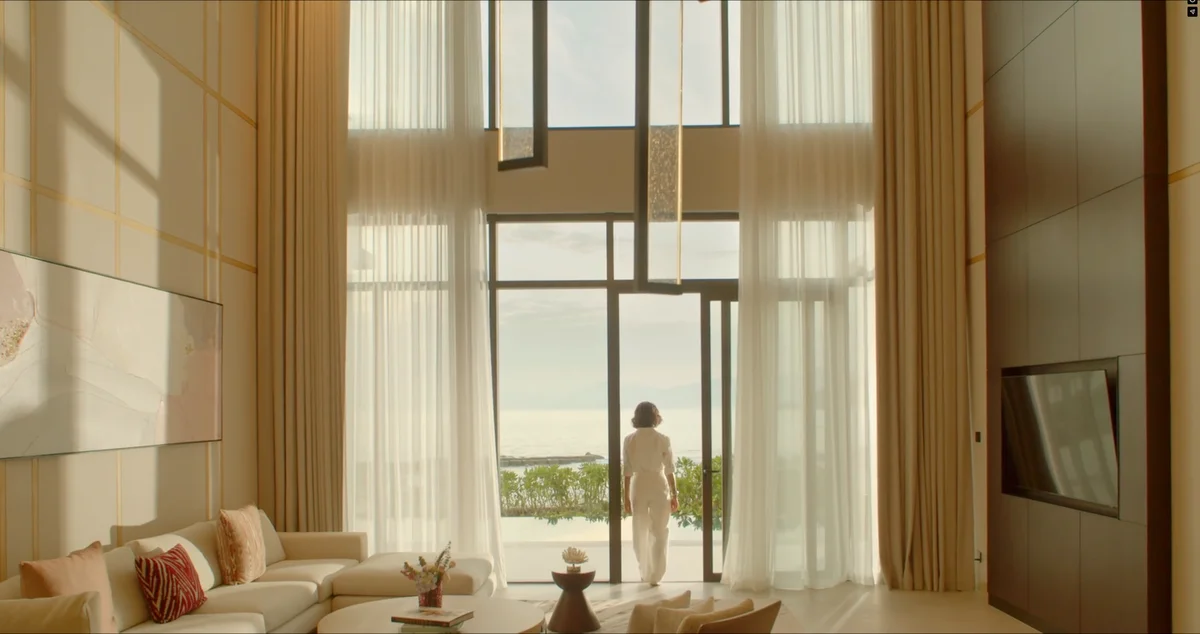
Hotel video rarely earns its budget when it’s treated like a sizzle reel. The properties that move bookings with video treat it as a commercial asset, planned against a demographic, timed to a season, and built to work across direct channels, OTAs, group sales, and investor decks.
Vietnam adds a layer most international brands underestimate. Three climate zones with different rainy seasons. Drone permits that sit with the military, not a civilian aviation authority. Luxury properties that stay open while you film. None of this is a barrier. It’s just planning.
Key Takeaways
- Direct-channel revenue for luxury hotels has climbed past OTA share in several markets. Video is central to that shift.
- Vietnam has three distinct climate zones. The right shoot month depends on the region, not the calendar.
- Budget runs $20,000 to $150,000 USD. Production quality, deliverables, and talent drive the range.
- Drone permits in Vietnam are issued by the military. Without a licensed, insured operator, coastal aerial coverage is at risk.
If you are planning a production in Vietnam generally, our overview of video production in Vietnam covers the wider landscape and our video production portfolio for hotels & resorts in Vietnam here.
What Hotel Video Is Actually For
In This Article
In 2023, 5-star hotels in Europe generated 38% of online revenue through the direct channel, and in Asia the figure reached 56% (D-EDGE Hotel Distribution Report, 2024). Hotels retain 95.82% of guest-paid revenue through their own channels versus 82.06% through OTAs (Punch Hospitality, 2026). Video is the asset that moves traffic to those direct channels.
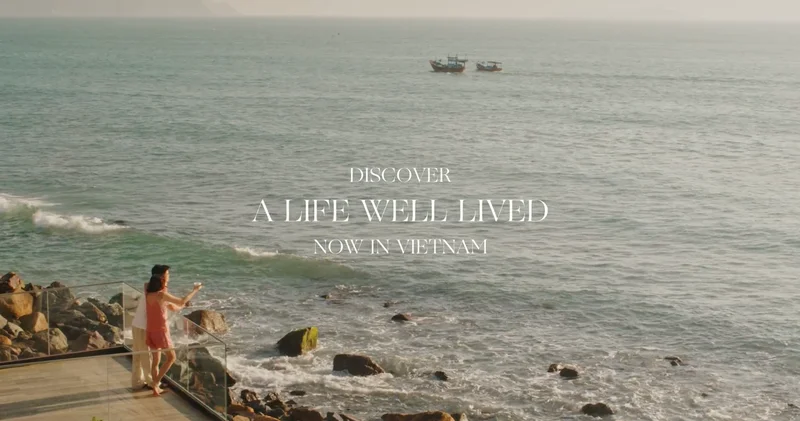
Hotel and resort video serves several jobs at once: direct bookings on the property’s own site, OTA listings, MICE and group sales decks, investor presentations, brand launches, and the social calendar that keeps a property visible between booking cycles. Each job wants something different. An OTA listing needs rooms, amenities, and confidence in ninety seconds. A MICE reel needs ballroom capacity a planner can picture. A social cut needs personality in the first three seconds. “Make it cinematic” is not a brief. It is a mood.
Premium positioning has also shifted. Guests are trading up to Superior and luxury rooms at a higher rate than Standard. Your video has to earn that choice.
How to Shoot Around Guests at an Operating Hotel
A luxury property with live guests is not a controlled set. Two decisions carry most of the risk, and both need to be locked weeks ahead of the crew’s arrival.
First, check the event calendar. Weddings, MICE blocks, holiday peaks, any large group in-house is a reason to hold the shoot. Second, align the shoot with the property’s best season so you are not fighting the weather to get the visuals the brand needs. These two decisions are often made late, because marketing is under pressure from ownership to deliver assets for a fixed campaign push. That pressure is where shoots go sideways.
On the shoots we run, we set up a group chat with the marketing lead and the relevant operations leads well before production begins. Concerns go on the table early. Housekeeping is the team that gets taxed hardest, pulled from regular rounds to turn rooms for camera or stage specific areas. A transparent conversation about the load on each department reduces friction once filming starts.
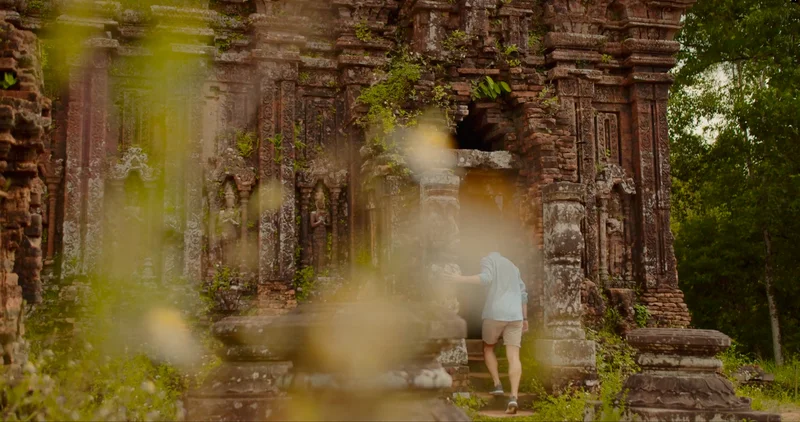
Once the crew is on property, the schedule does most of the work of staying out of guests’ way. Our peak filming windows for hotels and resorts are 4 AM to 9 AM and 3 PM to 6 PM. Guests on holiday operate on a different rhythm, so conflicts are rare at those hours. For public areas, we post signage in advance with the filming schedule so no one is caught off guard.
When to Film by Region in Vietnam
Vietnam does not share a single climate. When you film a property depends entirely on where it sits, and the gap between the right month and the wrong one is the difference between usable footage and a reshoot.
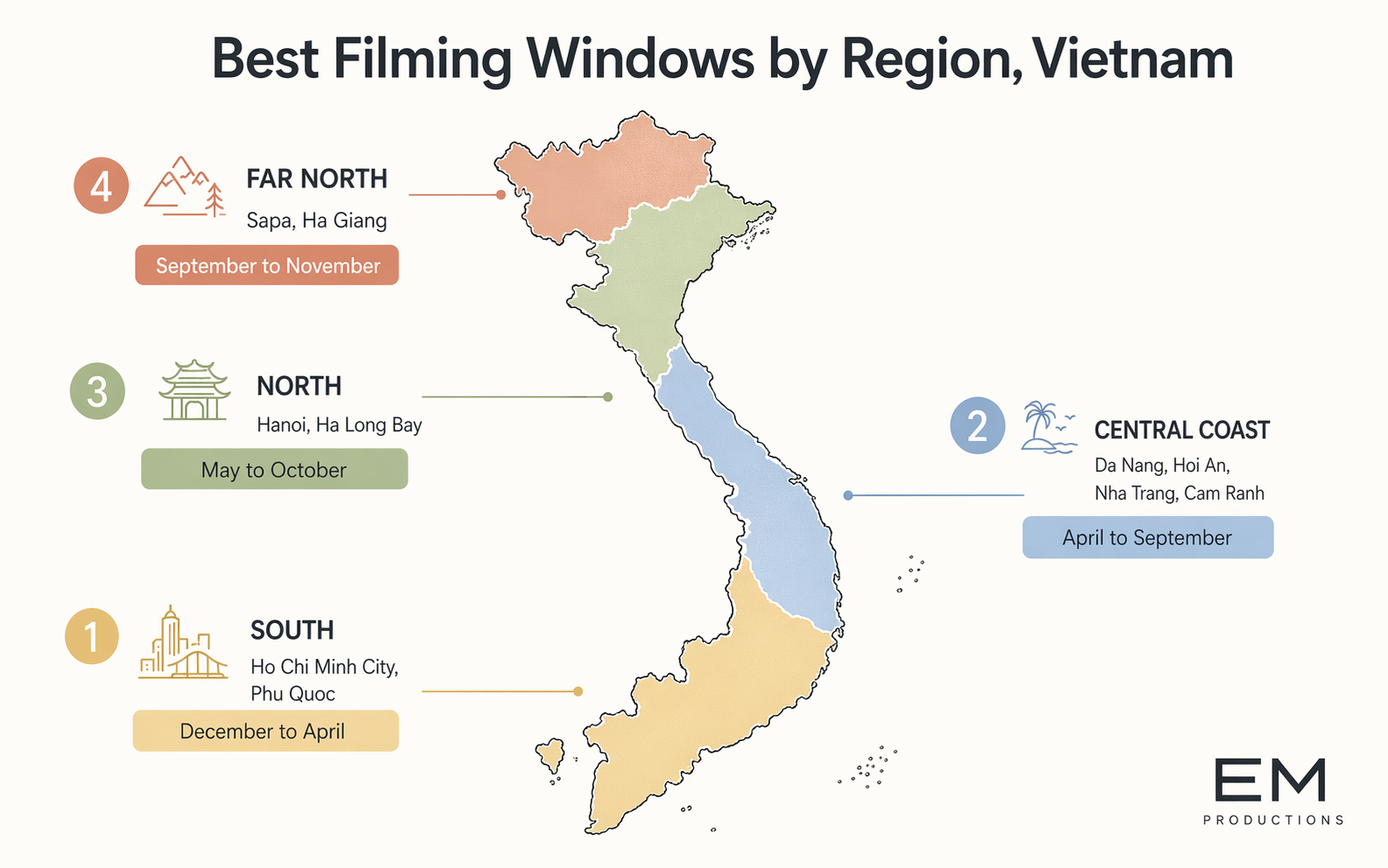
Ho Chi Minh City and Phu Quoc, the south, run December through April, edging into May.
Da Nang, Hoi An, Nha Trang, and Cam Ranh in central Vietnam run April through August or September.
Hanoi and Ha Long Bay in the north run May through October.
Sapa and Ha Giang in the far north run September through November, when the rice terraces are at their peak. A property selling that landscape is selling the harvest.
These are ideal windows. You can film outside them, but risks get harder to manage when you are coordinating actors, a crew of ten, a stylist, drone, and a fixed schedule. A rained-out day with a booked international talent on call is an expensive kind of flexibility.
We build a contingency day into hotel productions and keep the schedule flexible up to a set cut-off. Ahead of the cut-off, we run an advance weather report and put the go, push, or reschedule decision in the client’s hands.
The hard part is usually political, not meteorological. Marketing may see the forecast and want to reschedule. Ownership may be pushing to publish on a fixed date. We work with both sides to keep the outcome viable, sometimes by flipping a scene to a different time of day or shaping light to fake the conditions the brief called for. Production is not rigid. Flexibility is what separates experienced crews from the ones learning on your shoot.
For coastal and central-coast projects specifically, our video production in Da Nang page goes deeper on the logistics of shooting that region.
Why Camera-Ready and Guest-Ready Are Not the Same
There is a gap between a room that looks perfect to a guest and a room that holds up on a wide cinematic frame. Closing that gap is the styling problem, and most brands never see it until the final edit.
We approach it as a group effort. Our stylist works with housekeeping and management to stage each scene. During site visits, we audit details owners rarely notice, because they are not looking at the property through a camera. Lightbulb colours that read warm on the eye but orange on camera. Sightlines that need a lamp moved or a chair swapped. Reflections on a polished headboard. Flagging these during scouting means we are not burning production minutes fixing them on shoot day.
How much styling we bring depends on the client. Some properties want us to run a full styling team. Luxury brands with experienced in-house teams often handle most of the staging themselves to keep the production budget tighter. We scale to either. What makes it work is every department talking to each other early, not scrambling on shoot day.
How to Cast Talent for a Hotel Video
Casting is where a lot of hotel videos fail commercially before they ever go to edit. Most producers cast on taste. We cast on research.
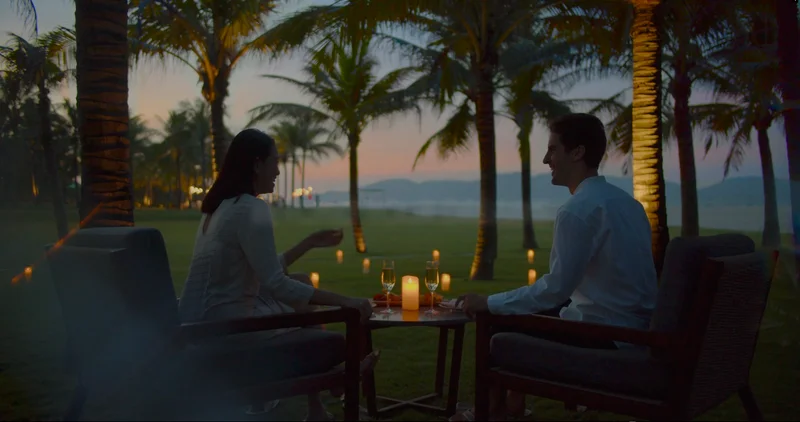
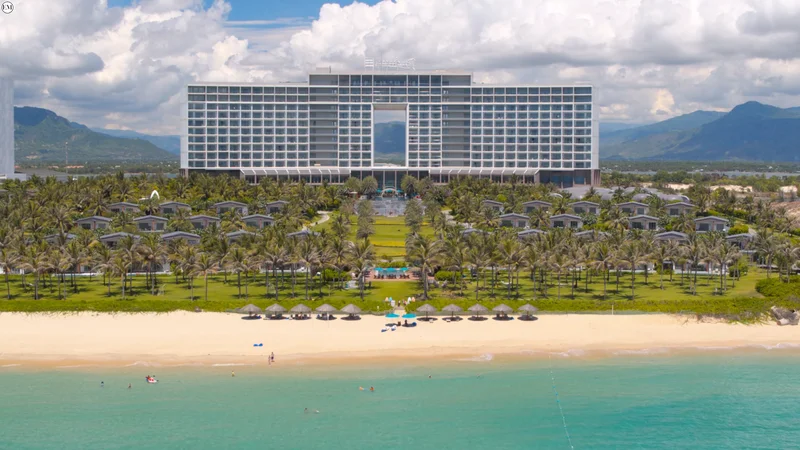
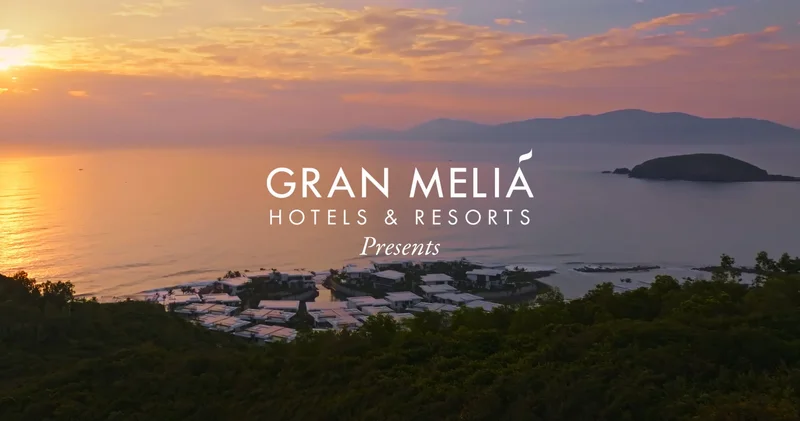
Before we recommend a face, we look at the demographic the property wants to reach, what that audience responds to in luxury, and what look is likely to drive booking intent. Sometimes the answer is a KOL. Sometimes a single traveller. Sometimes a family. For Gran Melia Nha Trang, research pointed to a Hollywood-recognised KOL. The campaign crossed four million views and drove a direct lift in bookings, the strongest brand result the property has had.
One cliché to avoid: the Western man paired with an Asian woman in a romantic setting. It is past its sell-by date in luxury hospitality, and there are almost always sharper creative choices.
A practical note on higher-tier talent. Once an actor has been used for a luxury hotel brand, they tend to be locked out of competing luxury work until that first campaign sunsets. If you are casting in that tier, rights windows and usage terms belong in the brief from day one.
What International Brands Need to Know About Drone Coverage in Vietnam
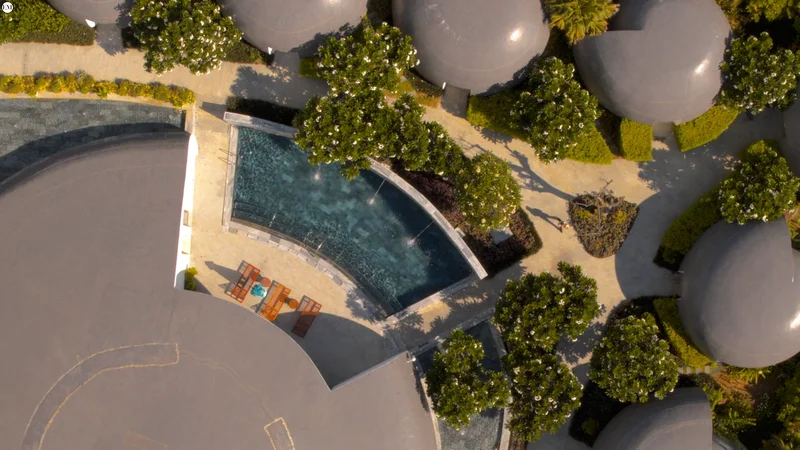
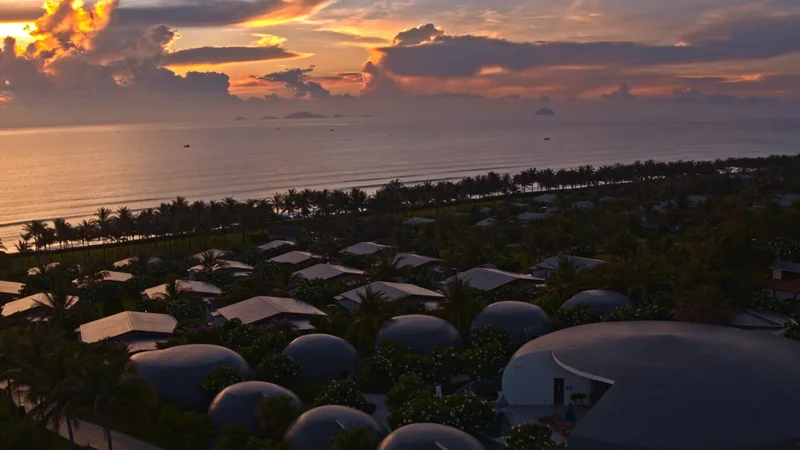
Drone footage, or flycam as it is called locally, is close to table stakes for resort video. It sets the geography, shows the property in context of its coastline or mountain, and opens up creative options a ground rig cannot deliver.
Two things most production posts skip. First, the guest experience. Drones are loud. Flying at the wrong hour next to an occupied pool deck earns complaints that reach the GM by lunch. Shoot aerials in the same early-morning and late-afternoon windows we use for the rest of production and you stay out of guests’ way.
Second, permits. In Vietnam, drone permits are issued by the military, not by a civilian aviation authority. That surprises most international brands. We hold the licensing and insurance required to operate, and have cleared permits for properties in challenging coastal locations, including sites close to airports, by adapting flight protocols to meet the safety requirements the military specifies. For a client, that means the aerial coverage promised in the brief shows up in the final cut.

What Separates Hotel Video That Drives Bookings
81% of hoteliers who implemented a first-party data strategy reported a revenue lift, with the top quartile seeing a 2.9x revenue increase (Sojern via Marketing Dive, 2022). Investment in owned brand marketing pays back. The question is what makes the video side of that investment perform.
We have produced hospitality video for six years and delivered four full end-to-end hotel and resort campaigns, alongside a steady flow of shorter-form work. Cinematic aesthetic is what pulled us into the space. Commercial result is what has kept us in it.
Three things separate hotel video that drives bookings from hotel video that just looks pretty.
First, market research before casting and creative. Who is the target guest, what moves them, and what creative language does that audience respond to in luxury? The Gran Melia campaign is our clearest case. Research drove the casting, the casting drove the social cut-downs, and the whole package drove the booking lift.
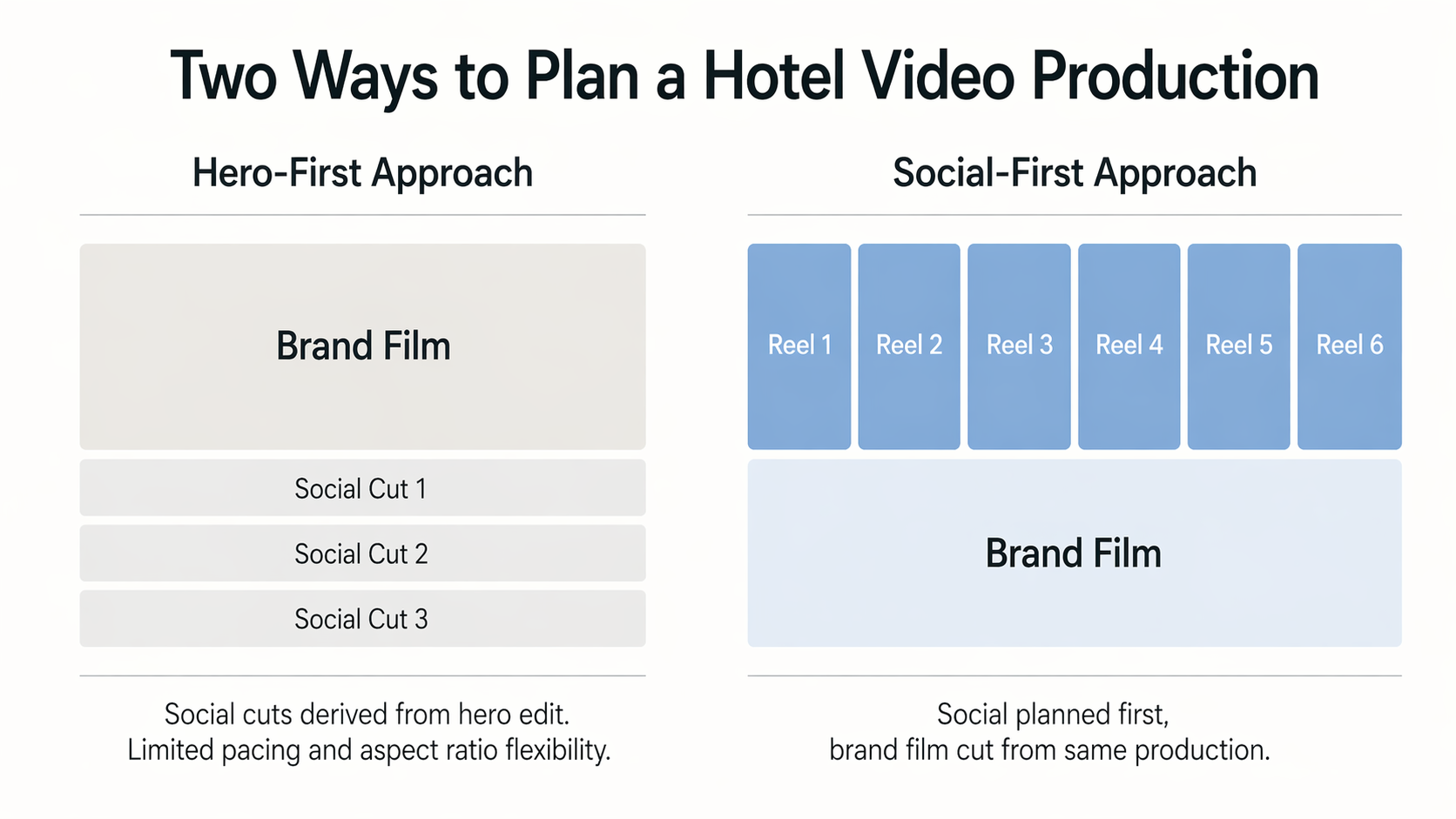
Second, a social-first build instead of a hero-first build. Cutting social reels from a hero edit rarely produces the frame rates, pacing, or aspect ratios that perform. Planning the social calendar first and cutting the hero from the same production gives marketing a content engine for the year from one shoot. Mews identifies short-form video as “one of the most powerful formats for capturing attention” (Mews, 2025).
Third, brief alignment done live. When a marketing director asks for “Aman style” or “cinematic,” we confirm what they mean in a live meeting with reference videos on screen, not a report they have to write. Feedback in the moment is faster, clearer, and aligns everyone before a single location is locked.
Hotel Video Production Checklist
Pre-Production
- Define the commercial goal: direct bookings, MICE, OTA, brand launch, or blended
- Lock the shoot window to the property’s best regional season
- Confirm no weddings, MICE blocks, or holiday peaks during production
- Build the shot list by area: lobby, rooms, suites, pool, F&B, spa, exterior, beach or landscape
- Decide the styling split between EM and in-house teams
- Complete demographic research before casting
- Secure flycam permits through the military with a licensed operator
- Build in a contingency day and a weather report cut-off
Production Days
- Shoot sunrise (4 AM to 9 AM) and late afternoon (3 PM to 6 PM) for exteriors and public spaces
- Post guest signage in advance for public-area filming
- Coordinate room access with housekeeping the night before each shoot day
- Keep a live group chat with marketing and ops during production
Post-Production
- Cut for every contracted deliverable: hero, OTA, MICE, social, internal
- Respect global brand guidelines on colour, type, and music
- Deliver in the aspect ratios and formats each platform actually needs
Hotel Video Production FAQ
How much does a hotel video cost in Vietnam?
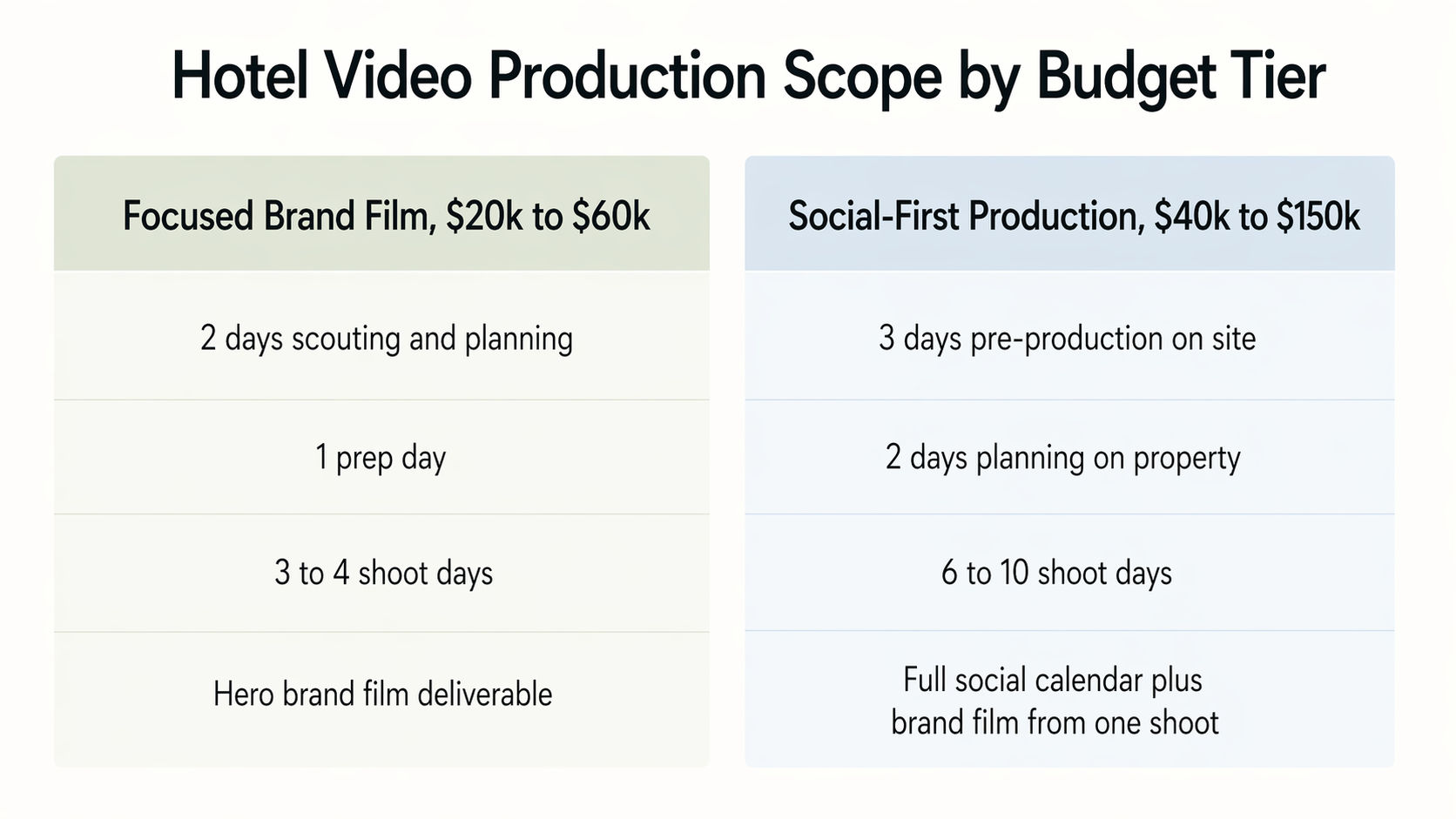
Hotel and resort video production in Vietnam generally runs between $20,000 and $150,000 USD. Production quality, brand expectations, deliverables, and talent drive the range. A focused brand film lives at the lower end: two days of scouting and planning, one prep day, and three to four shoot days. A social-first production, which we recommend for the strongest ROI, sits in the middle to upper half. Three days of pre-production on site, two days of planning on property, and six to eight shoot days. You walk away with a full content calendar of targeted reels plus a brand film from the same shoot. Producing everything in one project costs significantly less than bringing a crew back later.
Can you film a resort video while guests are staying at the property?
Yes. Most luxury hotel productions happen with guests in-house. The key is shooting within sunrise and late-afternoon windows, blocking rooms in coordination with housekeeping, and posting advance signage for public-area filming. Done properly, most guests never notice the crew.
Do you provide models and talent for hotel videos?
Yes. We cast from Asian talent pools matched to the demographic and market research for the property. For higher-tier talent, rights windows and usage terms belong in the brief from day one, because luxury hotel bookings tend to lock a face out of competing luxury work until the campaign sunsets.
What is the best time of year to film a resort in central Vietnam?
April through August or September is the window for Da Nang, Hoi An, Nha Trang, and Cam Ranh. That window gives you blue skies, calm seas, and the water colour that makes coastal footage work.
Can you produce hotel videos at multiple properties in Vietnam?
Yes. Our infrastructure supports multi-property productions anywhere in the country, from Phu Quoc and Ho Chi Minh City in the south to Da Nang, Nha Trang, and Cam Ranh in the centre, up to Hanoi, Ha Long Bay, Sapa, and Ha Giang in the north.
Should the general manager be involved in brand video decisions?
On a well-run hotel brand, marketing owns the vision and execution of video and photography, and the GM trusts them to deliver it. Global hotel brands run marketing independently of property operations for this reason. GMs move between properties more often than marketing directors do, and the commercial vision needs continuity that operations leadership is not structured to provide. The best results come when marketing has clear ownership and the GM supports the outcome without inserting personal taste into the creative.
Ready to plan your hotel video production
The productions that drive bookings treat video as a research-led, commercially scoped investment, not a sizzle reel with a bigger budget. If you are planning a hotel or resort video project in Vietnam, we can map the right production approach to your property, your target demographic, and your booking goals. Book a scoping call.